04_DomainClass
Code-Dateien
| Dateiname | Aktion |
|---|---|
| CODECode_Bank.zip | Download |
| CODECode_Pizza.zip | Download |
| CODECode_Taxi.zip | Download |
| CODECode_Urlaub.zip | Download |
PDF-Dokumente
| Dateiname | Aktion |
|---|---|
| PDFFolie_Basisklasse.pdf | Öffnen |
Videos
| Dateiname | Aktion |
|---|---|
| VIDEOVideo_Bank_D | Abspielen |
| VIDEOVideo_Pizza_E | Abspielen |
| VIDEOVideo_Taxi_D | Abspielen |
| VIDEOVideo_Urlaub_D | Abspielen |
Lernmaterialien
JPA
It is a standard way to map Java objects to database tables and work with relational databases using objects instead of writing a lot of raw SQL.
Example idea:
- a Java class like
PizzaOrder - becomes a database table
- each object becomes a row
JPA commonly uses annotations such as:
@Entity@Id@Table@Column
@Entity
@Entity (jakarta.persistence.Entity)
This class should be stored in a database table.
JPA understands that:
- This class represents a table
- The table name is usually
pizza_order(orPizzaOrder) - Each object = one row
- Each field = one column
import jakarta.persistence.Entity;

@Entity
public class PizzaOrder {
    ...
Now JPA:
- Tracks the class
- Creates/uses a database table
- Allows saving/loading objects
| order_id | order_date | pizza | size | price | quantity | garlic |
|---|---|---|---|---|---|---|
| 1 | 2026-04-11 | Margherita | Large | 12.5 | 2 | true |
@Id
@Id (javax.persistence.Id).
This field is the primary key of the entity.
JPA understands that:
orderIduniquely identifies each record- It becomes the PRIMARY KEY in the database
- No two rows can have the same
orderId
JPA needs it to:
- find an object →
find(PizzaOrder.class, 1) - update the correct row
- delete the correct row
import jakarta.persistence.Id;

@Entity
public class PizzaOrder {
    @Id
    private Long      orderId;
    ...

    private static final AtomicLong sequence = new AtomicLong(1000);

    public void setOrderId() {
        this.orderId = sequence.getAndIncrement();
    }
}
Optional: Auto-generated IDs
You can combine it with @GeneratedValue:
@Id
@GeneratedValue
private Long orderId;
!!! Not for NOW !!!
Properties
In JPA, we often use wrapper classes like
Long, Integer, Double, and
Boolean instead of primitive types like long,
int, double, and boolean because
wrapper classes can hold null.
boolean garlic→ onlytrueorfalseBoolean garlic→true,false, ornull
So Boolean can mean:
true= garlic requestedfalse= no garlicnull= not specified yet
    @Id
    private Long      orderId;
    private LocalDate orderDate;
    private String    pizza;
    private String    size;
    private Double    price;
    private Integer   quantity;
    private Boolean   garlic;
Lombok
https://projectlombok.org/api
Lombok is a Java library that reduces boilerplate code.
It can automatically generate things like:
- getters
- setters
- constructors
toString()equals()andhashCode()
So instead of writing a lot of repetitive code by hand, you add annotations.
pom.xml
        <dependency>
            <groupId>org.projectlombok</groupId>
            <artifactId>lombok</artifactId>
            <version>1.18.44</version>
            <scope>provided</scope>
        </dependency>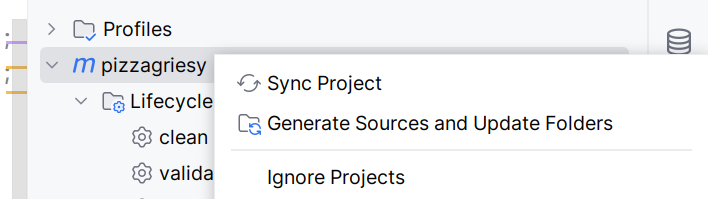
get set toString
@Getter
@Setter
@ToString
//@NoArgsConstructor
//@AllArgsConstructor
@EqualsAndHashCode (of = "orderId", callSuper = false)
@Entity
public class PizzaOrder {
test get set toString
    @Test
    public void testGetPizza() {
        PizzaOrder o1 = new PizzaOrder();
        PizzaOrder o2 = new PizzaOrder();
        o1.setPizza("Salami");
        o2.setPizza("Pepperoni");

        assertEquals("Salami", o1.getPizza());
        assertEquals("Pepperoni", o2.getPizza());
    }
override set Method
    private static final String[] sizes = { "Small", "Medium", "Large", "Family" };

    public void setPrice(Double price) throws PizzaOrderException {
        if (price < 8)
            throw new PizzaOrderException("The min. price is 8.0 Eur");
        if (price > 30)
            throw new PizzaOrderException("The max. price is 30.0 Eur");

        this.price = price;
    }

    public void setSize(String size) throws PizzaOrderException {
        if (Arrays.asList(sizes).contains(size) == false)
            throw new PizzaOrderException("Wrong size must be: " + Arrays.toString(sizes));
        this.size = size;
    }
Constructor
    public PizzaOrder() throws PizzaOrderException {
        setOrderId();
        setOrderDate(LocalDate.now());
        setPizza("Margherita");
        setSize("Large");
        setPrice(14.0);
        setQuantity(1);
        setGarlic(true);
    }

    public PizzaOrder(LocalDate orderDate, String pizza, String size, Double price, Integer quantity, Boolean garlic) throws PizzaOrderException {
        setOrderId();
        setOrderDate (orderDate);
        setPizza (pizza);
        setSize (size);
        setPrice (price);
        setQuantity (quantity);
        setGarlic (garlic);
    }

    public PizzaOrder(Long orderId, LocalDate orderDate, String pizza, String size, Double price, Integer quantity, Boolean garlic) throws PizzaOrderException {
        setOrderId(orderId);
        setOrderDate (orderDate);
        setPizza (pizza);
        setPizza (size);
        setPrice (price);
        setQuantity (quantity);
        setGarlic (garlic);
    }
clone
The clone() method in Java is used to create a
copy of an object.
Basic idea:
- original object exists
clone()makes another object with the same values
public class PizzaOrder implements Cloneable {

    @Override
    public PizzaOrder clone() {
        PizzaOrder clone = new PizzaOrder(orderId, orderDate, pizza, size, price, quantity, garlic);
        return clone;
    }
Exception
public class PizzaOrderException extends RuntimeExceptionThere is no need to add
throws PizzaOrderException in the method
header!!!